- +91 9828580244
-





.png)
.png)
Most people assume investing becomes difficult because markets are unpredictable. But modern investing is becoming difficult for a very different reason. The human brain is being pulled in too many directions at once.
Every day, investors are surrounded by systems designed to capture attention continuously. Notifications appear instantly. Financial creators post dramatic predictions every hour. Market apps refresh endlessly. Social media constantly displays someone making faster money, taking bigger risks, or achieving visible success more quickly.
And somewhere inside all of that noise, long-term investing is trying to survive quietly.
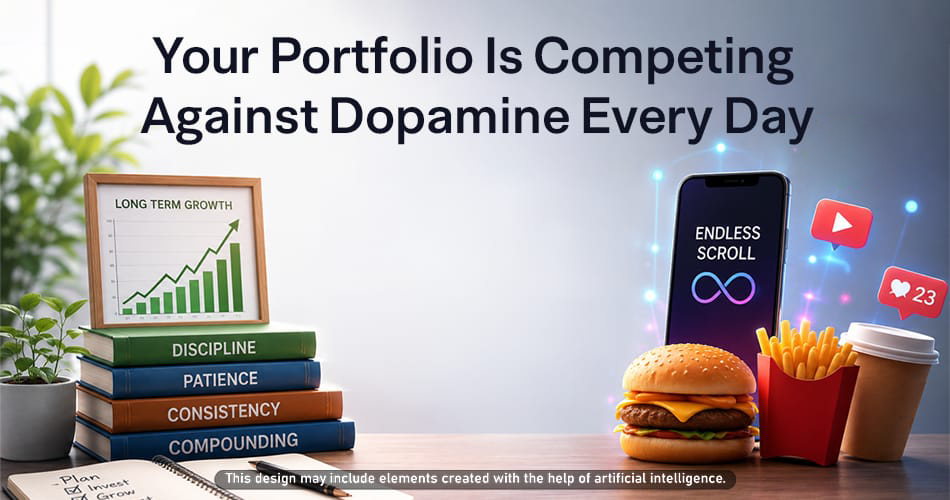
That changes the emotional experience of investing far more than most people realize. Because your portfolio is no longer competing only against inflation or market volatility. It is increasingly competing against the constant stimulation of modern digital environments.
Dopamine is often misunderstood as something connected only to happiness or pleasure. In reality, it behaves more like the brain’s anticipation system. It reacts strongly to novelty, uncertainty, emotional stimulation, and the possibility of reward. It is one reason people refresh apps repeatedly, check notifications constantly, and feel drawn toward whatever appears exciting in the moment.
Modern digital platforms understand this deeply.
That is why so much online content feels designed to keep people emotionally engaged. Apps reward checking behaviour. Algorithms amplify emotionally intense content. Financial headlines are often written dramatically because dramatic information tends to attract more attention than balanced information.
Over time, the brain adapts to this environment.
Silence begins feeling uncomfortable. Stillness begins feeling unproductive. Slow progress begins feeling emotionally unsatisfying.
Unfortunately, disciplined investing often looks exactly like those things.
A SIP running every month does not create excitement. Diversification does not feel emotionally thrilling. Compounding rarely provides visible rewards in the beginning. Long-term wealth creation often appears repetitive and uneventful while it is quietly working in the background.
This creates an emotional contrast for modern investors. The world around them keeps rewarding stimulation, while investing often asks for patience.
Earlier generations experienced money differently. Markets existed, but they did not exist inside people’s pockets every minute of the day. Investors were not constantly exposed to portfolio updates, market commentary, predictions, and comparisons from morning until night.
Today, that distance barely exists.
A person can wake up and immediately see global market news before getting out of bed. During breakfast, they scroll through financial content. At work, notifications continue appearing. By evening, they may have already consumed dozens of opinions about where markets are supposedly heading next.
The market no longer feels like something investors visit occasionally. It often feels like something that follows them throughout the day.
While greater access to information has many benefits, constant exposure can also change the way people experience investing emotionally.
At first, the changes seem harmless.
An investor begins checking their portfolio more frequently. They start watching more financial videos. They compare returns more often. They become increasingly focused on every market movement.
Eventually, investing can stop feeling like a long-term financial process and start feeling like a continuous emotional experience.
A rising portfolio improves mood. A red market creates anxiety. A sudden gain feels rewarding. A correction feels personal.
This is one reason many people open their investment apps repeatedly without any intention of actually making changes. The brain is often seeking information, reassurance, or stimulation.
Over time, this can influence expectations.
Long-term investing begins feeling emotionally slow. Quiet progress begins feeling invisible. Consistency may start feeling boring compared to the highly stimulating environment surrounding investors online.
This is one of the biggest hidden shifts happening in modern finance.
People often assume investing mistakes happen mainly because investors are greedy or uninformed. But many investors today are highly aware financially. They understand inflation. They understand compounding. They understand diversification and long-term thinking much earlier than previous generations did.
The challenge is no longer only knowledge.
It is information overload combined with emotional overstimulation.
Every day, investors encounter a constant stream of opinions. One creator explains disciplined investing calmly. Another promotes aggressive trading. Another predicts a market crash. Another displays luxury supposedly funded through rapid investment success.
Investors absorb all of this emotionally, even when they understand that much of social media represents selective outcomes rather than complete reality.
Over time, this can create a subtle psychological effect.
Ordinary financial progress begins feeling emotionally insufficient. A person investing consistently through SIPs for years may actually be behaving responsibly. But emotionally, the process can feel underwhelming when compared against constant stories of rapid success elsewhere.
That comparison can gradually influence behaviour.
Investors begin questioning patience. They feel tempted to optimise constantly. They start believing they should always be doing something more with their money.
Reading more. Adjusting more. Reacting faster. Taking bigger risks. Searching for stronger emotional rewards.
Stillness starts feeling irresponsible.
But long-term investing often depends precisely on the ability to remain disciplined when emotions are pushing people toward unnecessary action.
This is one environment where behavioural mistakes can become more likely.
Not necessarily because investors suddenly become reckless, but because ordinary progress no longer feels satisfying enough. People begin interrupting healthy long-term systems in search of stronger stimulation.
Investors may switch strategies too quickly. They may react emotionally to temporary market movements. They may pause investments during uncertainty or increase risk impulsively after seeing others appear successful online.
These decisions rarely feel irrational in the moment.
They often feel emotionally justified because the investor has been exposed to constant stimulation, comparison, and urgency for an extended period of time.
This is why modern investing increasingly resembles an attention-management challenge as much as a financial challenge.
The investor who succeeds over long periods may not necessarily be the one consuming the most financial content or reacting the fastest to market changes. It may simply be the person most capable of maintaining emotional stability while surrounded by constant stimulation.
That skill is becoming increasingly valuable.
Because the internet trains people emotionally in the opposite direction. It encourages novelty, faster feedback, more excitement, and more visible progress.
Investing still operates differently.
Compounding remains slow in the beginning. Discipline remains repetitive. Long-term wealth creation still depends heavily on patience.
Technology has evolved rapidly. Human psychology has not evolved at the same speed.
This is one reason structured investing systems can be valuable.
For example, SIPs may help reduce the need for repeated investment decisions. Instead of asking investors to decide every month whether markets feel safe or exciting enough to invest in, the process continues systematically across different market phases.
Similarly, mutual funds may help simplify decision-making through diversified investment structures managed within a long-term framework. Investors do not need to react to every company movement, every prediction, or every short-term trend individually.
This does not eliminate market risk. It does not guarantee returns. And it does not remove volatility.
However, it may help reduce some of the emotional fatigue created by constant information consumption and short-term market noise.
That distinction matters in modern investing environments.
Future investing success may depend less on who reacts the fastest and more on who can remain emotionally steady while surrounded by constant stimulation.
The internet rewards novelty. Long-term investing often rewards consistency.
The internet rewards excitement. Long-term investing often rewards restraint.
The internet rewards immediate engagement. Long-term investing often rewards delayed gratification.
These are fundamentally different emotional systems, and modern investors are trying to operate within both at the same time.
That is why disciplined investing can sometimes feel disconnected from the modern digital world. Quiet financial behaviour rarely attracts attention, yet it is often the behaviour that supports long-term goals most effectively.
A portfolio does not need to create excitement every day to support financial goals. In many cases, the healthiest investing behaviour feels almost uneventful while it is happening.
And that may actually be one of the strongest signs that emotions are no longer controlling the process.
Because sometimes the challenge in investing is not predicting markets. It is maintaining patience in an environment that constantly competes for attention.
This content is for investor education only. This blog should not be treated as investment advice or a recommendation. Mutual Fund investments are subject to market risks, read all scheme related documents carefully.
Imperial Prime Capital Private Limited was established in 13th April 2006 withvery client-centric organization with a strong work ethic. Our focus is to ensure and protect the client’s interest.
Imperial Prime Capital Private Limited
Plot No. 140/23, Flat No. 1, The Foresta Block-C, Shipra Path, Near Petrol Pump, Mansarovar, Jaipur (302 020) Rajasthan India
Manish: +91 9828580244
Office: +91 7014870794
ARN: 41427
GST No.: 08AABCI5118D1ZY
Copyright © Imperial Prime Capital Private Limited. All rights reserved.
AMFI Registered Mutual Fund Distributor | ARN- 41427 | Date of initial Registration: 28/06/2006 | Current validity of ARN-41427: 30/06/2026.
Risk Factors – Investments in Mutual Funds are subject to Market Risks. Read all scheme related documents carefully before investing. Mutual Fund Schemes do not assure or guarantee any returns. Past performances of any Mutual Fund Scheme may or may not be sustained in future. There is no guarantee that the investment objective of any suggested scheme shall be achieved. All existing and prospective investors are advised to check and evaluate the Exit loads and other cost structure (TER) applicable at the time of making the investment before finalizing on any investment decision for Mutual Funds schemes. We deal in Regular Plans only for Mutual Fund Schemes and earn a Trailing Commission on client investments. Disclosure For Commission earnings is made to clients at the time of investments. Option of Direct Plan for every Mutual Fund Scheme is available to investors offering advantage of lower expense ratio. We are not entitled to earn any commission on Direct plans. Hence we do not deal in Direct Plans.
Important Links | Disclaimer | Disclosure | Privacy Policy | SID/SAI/KIM | Code of Conduct | SEBI Circulars | AMFI Risk Factors